Zapper is an Ethereum-first portfolio dashboard for DeFi, NFTs, and wallets
Zapper is an Ethereum-first Web3 dashboard that turns a wallet address into a readable portfolio view across tokens, DeFi positions, NFTs, and protocol activity. A user can paste an address or connect a wallet to see balances grouped by assets and apps, including liquidity pools, lending positions, staked tokens, collectibles, and wallet history. Its value is the translation layer: raw onchain data becomes a practical inventory of what a wallet holds and where those assets sit.
Wallet addresses become a live portfolio map
The core workflow starts with an address. Public blockchains already expose token transfers, contract interactions, and balances, yet that data arrives in a format built for machines and explorers. This dashboard reads the same public record and organizes it into a portfolio map, separating wallet holdings from positions that live inside protocols. That distinction matters when assets are deposited into a lending market, paired in an AMM pool, wrapped, bridged, or represented by receipt tokens.
At its core, Zapper treats a wallet as an onchain identity rather than a single account balance. A plain ETH holding, an ERC-20 token, a Uniswap liquidity position, an Aave deposit, and an NFT collection all point to different smart contracts. The interface gives those contract relationships human labels, current balances, and portfolio context, so the user sees a financial picture instead of a sequence of contract calls.
Where Ethereum DeFi positions show up
DeFi positions rarely stay visible as simple token balances. Supplying USDC to a lending protocol creates a claim on deposited liquidity. Adding WETH and another asset to an automated market maker creates exposure to both sides of a pool. Staking, vault shares, and reward contracts add another layer of accounting. A portfolio viewer earns its place by identifying those protocol-specific positions and showing them beside idle wallet assets.
Inside Zapper, token balances and protocol cards sit together so a wallet owner can connect the dots between asset allocation and app usage. Ethereum remains the reference point for many of these integrations because ERC-20 tokens, ERC-721 NFTs, and DeFi primitives originated there at scale. The same style of indexing also fits EVM networks such as Polygon, Arbitrum, Optimism, Base, and BNB Chain, where wallet addresses and smart contract standards follow similar patterns.
NFT inventory beside tokens and pools
NFTs change the portfolio question from only "how much is this wallet worth?" to "what exactly does this wallet own?" A token balance gives a number. An NFT position needs collection identity, token ID, media, metadata, and market context. Showing NFTs beside fungible holdings helps a user understand whether a wallet is concentrated in liquid assets, collectibles, gaming items, membership passes, or long-tail digital objects.
Pricing NFTs is less exact than pricing major ERC-20 assets. Floor prices move, rare traits change the real market, and illiquid collections produce stale estimates. The useful view is still the inventory: collection names, individual items, and the chain where each item lives. A serious wallet review separates this display data from an assumption that every collectible sells instantly at the shown estimate.
Starting from an address before connecting anything
Opening Zapper with a public wallet address is the cleanest first step. Paste an ENS name or a hexadecimal address, scan the portfolio, and decide whether the information matches what you expect. Connecting a wallet becomes relevant when the user wants a smoother personal dashboard, faster navigation, or an action that requires signing. Address lookup alone is enough for watchlists, research, and checking how a known wallet interacts with apps.
This read-first workflow also suits people who manage several wallets. A hardware wallet, a mobile wallet, and a burner wallet hold different risk profiles and different assets. Viewing them side by side reduces the chance that an LP position, a small claimable reward, or an NFT on a secondary network gets forgotten. The same habit helps after moving assets between wallets, because the user sees whether the old address still contains dust, approvals, or active positions.
What the dashboard adds beyond a block explorer
A block explorer such as Etherscan is the source of truth for transaction detail, contract verification, logs, approvals, and exact execution history. A portfolio dashboard serves a different job: it compresses the same public activity into categories that match how people think about holdings. Explorer tabs answer "what happened in this transaction?" Portfolio views answer "what does this address currently hold, and where?"
Zapper surfaces the relationships between assets and apps without requiring the user to read every event log. That is especially helpful after a wallet has touched many protocols over several market cycles. The owner sees which assets remain liquid in the wallet, which balances are wrapped into protocol shares, which networks hold small amounts of gas, and which NFT collections still sit under the same address.
Swaps, gas, and approvals around portfolio actions
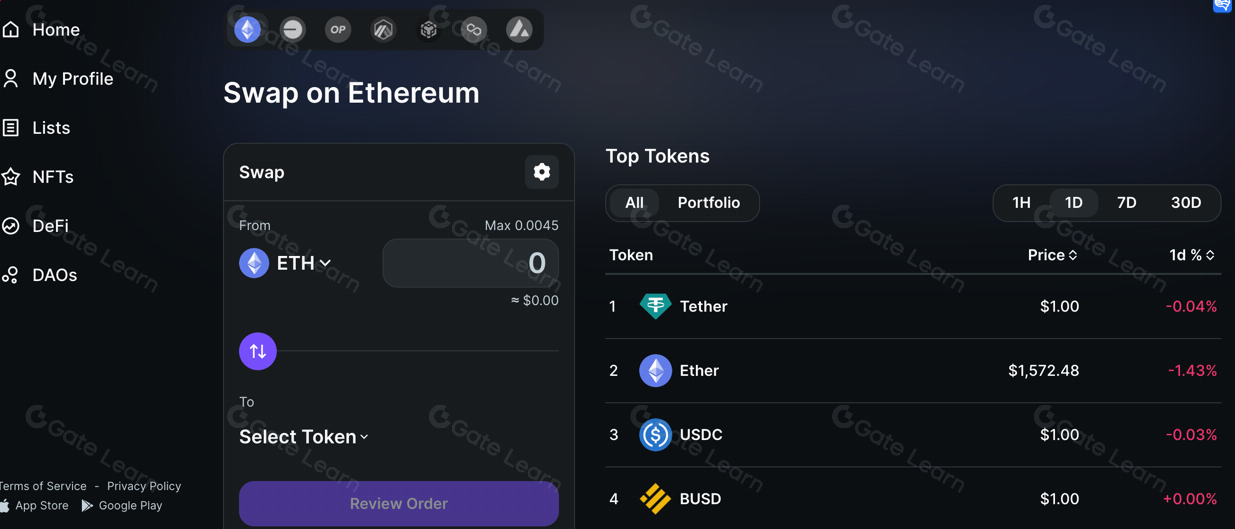
Portfolio dashboards increasingly sit close to transaction workflows: swapping, bridging, claiming rewards, or entering and exiting DeFi positions. Every action still resolves through a wallet signature and a blockchain transaction. Gas is paid on the network used for execution, so ETH pays on Ethereum mainnet, while networks such as Base and Arbitrum use ETH for gas and Polygon uses POL.
Approvals deserve special attention because they authorize a smart contract to move a token up to a permitted amount. A clean interface helps the user see the intended asset and destination, but the wallet prompt is the final checkpoint before the transaction broadcasts. That is the one caution worth making concrete: review the token, chain, spender, and amount in the wallet prompt before signing an approval or swap.
Multi-chain tracking without losing the wallet story
As assets spread across EVM networks, a single address can represent activity on several chains. The same address format appears on Ethereum, Optimism, Arbitrum, Base, Polygon, and other compatible networks, but balances and transaction histories remain chain-specific. A useful tracker preserves that distinction while still presenting the address as one portfolio.
That is where Zapper becomes more useful than a spreadsheet. It groups chain-level data into a wallet-level story: which network holds the main liquidity, where gas is available, which DeFi apps are active, and whether NFT holdings are clustered on one chain. Cross-chain viewing also highlights operational gaps, such as a wallet holding bridged assets on a network without enough native gas to move them.
Zerion, DeBank, and explorer tabs in the same workflow
Zerion, DeBank, Etherscan, OpenSea, and wallet-native portfolio screens overlap with parts of this use case. Zerion is polished for wallet tracking and mobile-friendly portfolio views. DeBank is widely used for DeFi-heavy address research and social wallet discovery. Etherscan remains essential for raw transaction inspection and contract-level verification. OpenSea and marketplace interfaces go deeper into collection pages, listings, offers, and NFT market behavior.
That said, Zapper is strongest when the job is a quick, visual read of wallet holdings across DeFi and NFTs, especially for users who want protocol positions translated into plain portfolio categories. It does not replace every specialist tool. It works best as the dashboard layer in a broader routine: use it for the portfolio picture, use explorers for forensic detail, and use wallet prompts as the signing boundary when taking action.
Who gets the most value from this type of tracker
People with one exchange account and a single spot token balance receive limited benefit from an onchain portfolio dashboard. The advantage grows once a wallet touches smart contracts, owns NFTs, uses several EVM chains, or follows other public addresses. Researchers use it to understand wallets quickly. Active DeFi users use it to avoid losing track of positions. NFT collectors use it to see assets and token balances in the same place.
The best experience comes from treating the dashboard as an organizer for public blockchain data. It turns scattered token contracts, pool shares, and collectible metadata into a page that is easy to revisit. When paired with a reliable wallet, a block explorer, and disciplined signing habits, it becomes a practical control panel for Ethereum-centered onchain activity.
What to know about Zapper
Does the dashboard charge a fee to view wallet balances?
Viewing public wallet balances is a read-only activity, so the portfolio screen itself does not require a blockchain transaction or gas payment. Costs appear when a user takes an onchain action such as swapping, bridging, claiming, or approving a token. Those actions use the target network and are paid in that network's gas asset, such as ETH on Ethereum, Base, Optimism, and Arbitrum.
Which wallets work with Zapper for connected portfolio viewing?
Connected viewing works with common Web3 wallets that support Ethereum-style signing and browser or mobile wallet connections. MetaMask, Coinbase Wallet, WalletConnect-compatible wallets, and hardware-wallet setups routed through a wallet interface fit the normal pattern. A user can also paste an address without connecting a wallet, which is enough for watching public balances and protocol positions.
Can I track a wallet that I do not own?
Yes. Public blockchains expose balances and transactions by address, so any compatible address can be viewed if the indexing layer recognizes its assets and protocols. That makes the tool useful for following treasury wallets, public collector addresses, or a personal watchlist. Ownership only matters when an action requires a wallet signature, such as approving a token or submitting a transaction.
Why do DeFi balances sometimes differ from a block explorer?
A block explorer shows exact contract data, while a portfolio dashboard interprets that data into human-readable positions. Differences appear when a protocol updates its contracts, an indexer has not refreshed yet, an asset lacks reliable pricing, or a position is represented by receipt tokens and internal accounting. For exact transaction history, the explorer view remains the detailed record.
Are NFT values shown the same way as ERC-20 token values?
No. ERC-20 prices come from liquid markets and pricing feeds, while NFT estimates depend on collection floors, recent sales, traits, and marketplace liquidity. The inventory view is usually more reliable than the valuation for thinly traded collections. Treat NFT pricing as market context and use collection pages or marketplace activity when a sale, bid, or transfer depends on current demand.
Does a portfolio viewer reveal private keys or seed phrases?
A portfolio viewer reads public blockchain data and wallet-provided account information. It should never need a seed phrase or private key to display balances. Connecting a wallet authorizes the site to see the selected address and request signatures for user-approved actions. Signing is separate from viewing, and seed phrases belong only in the wallet recovery process.